Brief Summary
Gastric sleeve surgery is a commonly performed bariatric procedure, but it may not be suitable for every patient.
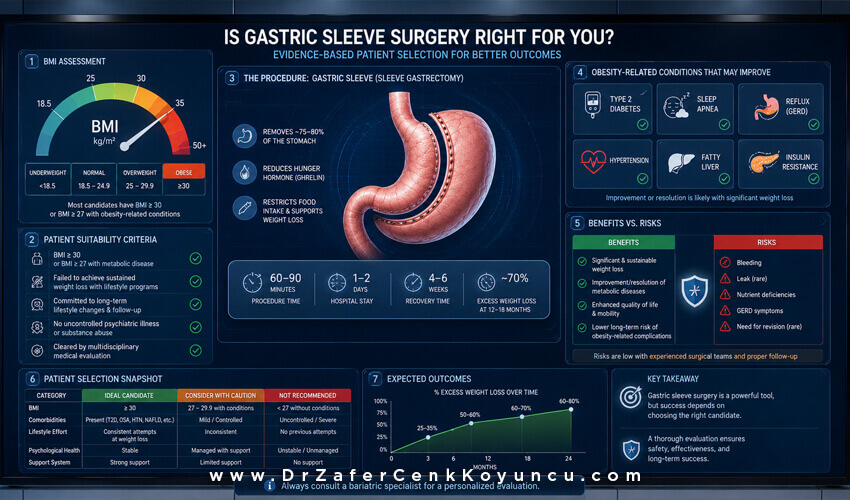
Eligibility should be evaluated together with BMI, metabolic conditions, reflux, sleep apnea, anesthesia risk and post-surgery compliance.
Is Gastric Sleeve Surgery Suitable for Everyone?
Gastric sleeve surgery is often researched by patients who want to lose significant weight. However, having excess weight does not automatically mean that a patient is suitable for this procedure. In bariatric surgery, the aim is not only weight loss. The broader goal is to support better metabolic health, reduce obesity-related risks and help the patient move toward a sustainable lifestyle.
For this reason, the decision should not be based only on the question “How much should a patient weigh?” Body mass index, associated diseases, stomach and esophageal health, previous weight loss attempts, anesthesia suitability and long-term follow-up compliance should all be assessed together.
Why Is BMI Important?
Body Mass Index, or BMI, is one of the main measurements used to evaluate weight in relation to height. It is an important starting point in bariatric surgery assessment, but it is not enough on its own.
Two patients with the same BMI may have completely different medical risks. One patient may have type 2 diabetes, hypertension and sleep apnea, while another may have severe reflux, a hiatal hernia or different surgical concerns. Therefore, BMI should be considered as only one part of the decision-making process.
A proper evaluation should focus on how excess weight affects the patient’s health. Excess weight may influence blood sugar control, blood pressure, breathing, liver health, joint load and daily quality of life.
How Do Metabolic Conditions Affect the Decision?
During gastric sleeve evaluation, conditions such as type 2 diabetes, insulin resistance, metabolic syndrome, fatty liver disease, sleep apnea and hypertension should be reviewed carefully. Obesity is not only an aesthetic concern; it is a medical condition linked to several systemic diseases.
For example, in a patient with type 2 diabetes, blood sugar control, medications, insulin use and duration of disease are important. In patients with sleep apnea, anesthesia planning and post-surgery respiratory monitoring may require additional attention.
The right question is not only “Is the patient heavy enough for surgery?” A better question is: “Which health problems are related to obesity in this patient, and which treatment option may be most appropriate?”
Is Gastric Sleeve the Best Option for Every Patient?

No. Gastric sleeve surgery may be effective for many patients, but it is not the best method for everyone. Patients with severe reflux, esophageal problems, hiatal hernia, previous stomach surgery or uncontrolled metabolic disease may require more detailed evaluation.
In some cases, gastric bypass, mini gastric bypass, gastric balloon or non-surgical medical follow-up may also be considered. The method should not be selected from a fixed template; it should be chosen according to the patient’s medical profile.
What Does Pre-Surgery Evaluation Include?
Before gastric sleeve surgery, the goal is not only to prepare the patient for the operating room. The goal is to choose the right method safely. This process may include blood tests, metabolic assessment, endoscopy, anesthesia evaluation and, when necessary, cardiology or pulmonology consultation.
Endoscopy is especially important for evaluating the stomach and esophagus. If reflux, gastritis, hiatal hernia or another condition is present, the surgical plan may need to be adjusted accordingly.
Why Is Patient Compliance So Important?
Gastric sleeve surgery reduces stomach volume, but long-term success is closely related to post-surgery compliance. Nutrition, protein intake, hydration, vitamin and mineral monitoring, movement and regular follow-up visits are key parts of the process.
If the patient sees surgery as a passive solution that requires no effort, long-term results may be negatively affected. For this reason, expectations should be discussed realistically before surgery.
Conclusion
Gastric sleeve surgery can be an effective surgical option in obesity treatment when the right patient is selected. However, it is not suitable for every patient. BMI, metabolic conditions, reflux, sleep apnea, stomach and esophageal health, surgical risks and long-term follow-up compliance should be evaluated together.
The most appropriate approach is not to offer the same method to every patient, but to create an individualized treatment plan based on the patient’s health status, risk profile and goals.
Take the First Step Toward a Personal Evaluation
To understand whether gastric sleeve surgery is suitable for you, an individualized medical evaluation is necessary.
You can plan an initial consultation with the team of Dr. Zafer Cenk Koyuncu to assess your BMI, metabolic conditions and surgical suitability professionally.
Request an Expert Evaluation