Brief Summary
Fat accumulation in the liver is closely associated with obesity, insulin resistance and type 2 diabetes. Meaningful and sustained weight loss can improve liver fat and may support better metabolic and liver health.
Obesity and Fatty Liver Disease
When people think about the health consequences of obesity, they often think first about diabetes, high blood pressure, joint problems or cardiovascular disease. The liver is sometimes overlooked.
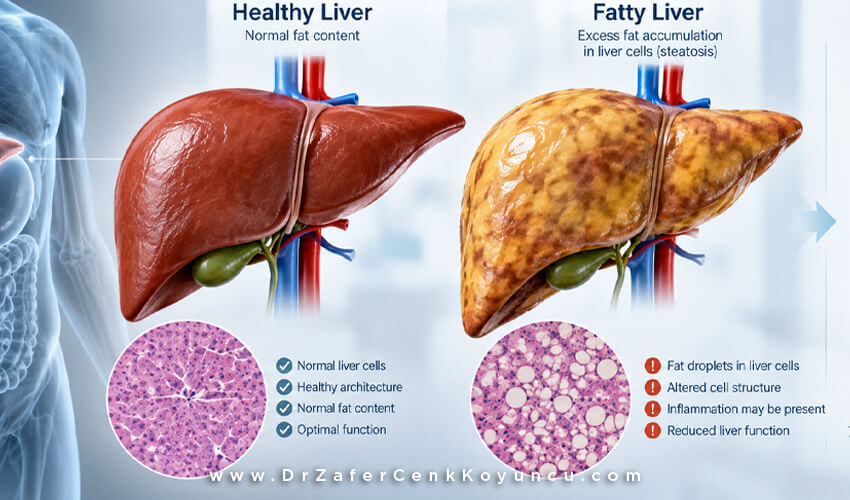
However, excess body weight can have an important effect on liver health. When excessive fat accumulates inside liver cells, steatotic liver disease can develop.
When this occurs in association with metabolic problems such as obesity, insulin resistance or type 2 diabetes, the condition is commonly described as metabolic dysfunction-associated steatotic liver disease, or MASLD.
Many patients may still recognise the older term non-alcoholic fatty liver disease or NAFLD.
Why Does Fat Accumulate in the Liver?
The liver plays a central role in energy metabolism. It helps regulate glucose, fats and many other nutrients.
When the body consistently stores more energy than it uses, fat can accumulate not only under the skin but also around organs and within the liver.
Insulin resistance is particularly important. When normal insulin signalling becomes less effective, the regulation of glucose and fat metabolism becomes disrupted. More fatty acids can reach the liver and the liver itself may increase fat production.
Is Fatty Liver Disease Common in People With Obesity?
Obesity is one of the major risk factors for metabolic fatty liver disease.
The association becomes especially important when obesity occurs together with:
- Type 2 diabetes
- Insulin resistance
- High triglycerides
- Abnormal cholesterol levels
- High blood pressure
- Central or abdominal obesity
These conditions frequently occur together because they share underlying metabolic mechanisms.
Can Fatty Liver Exist Without Symptoms?
Yes. Many people with fatty liver disease have no obvious symptoms.
Some may experience nonspecific fatigue or discomfort in the upper right abdomen, but many feel completely well.
In some cases, abnormal liver enzymes are found during routine blood testing. In others, liver fat is noticed during ultrasound, CT or another imaging test performed for a different reason.
Is Fat in the Liver Always Dangerous?
Not every person with liver fat will develop advanced liver disease.
Some patients mainly have fat accumulation. Others can develop inflammation and liver-cell injury, which may progress to metabolic dysfunction-associated steatohepatitis, or MASH.
Continued inflammation can contribute to fibrosis, meaning scar tissue develops within the liver. More advanced fibrosis can eventually progress to cirrhosis in a smaller proportion of patients.
The aim is not to create fear, but to identify which patients may be at increased risk.
Why Is Weight Loss Important for Liver Health?
The encouraging aspect of metabolic fatty liver disease is that the liver can respond positively to weight reduction.
Meaningful and sustained weight loss may reduce liver fat and can also improve inflammation and metabolic health.
This means weight reduction should not be viewed only as a cosmetic goal. Important metabolic improvements may already be occurring before a patient reaches an ideal body weight.
What Happens to Liver Fat When Weight Decreases?
When body weight decreases and insulin sensitivity improves, less excess energy is directed toward fat storage.
The amount of fat reaching and being produced by the liver may fall, allowing liver fat to decrease over time.
Some patients may also experience improvement in liver enzymes, blood glucose, insulin sensitivity and triglyceride levels.
Can Exercise Help?
Yes. Physical activity is important not only because it helps weight management but also because it improves insulin sensitivity, cardiovascular health and metabolic function.
A combination of aerobic activity and resistance exercise can be useful when adapted to the patient's medical condition and physical ability.
Nutrition and Liver Health
There is no single detox diet that reverses metabolic fatty liver disease.
The more useful approach is a sustainable eating pattern that supports long-term metabolic health.
Common principles may include:
- Reducing excessive calorie intake
- Limiting highly processed foods
- Limiting sugar-sweetened beverages
- Reducing excessive refined carbohydrates
- Choosing healthier fat sources
- Increasing vegetables and fibre-rich foods
- Choosing appropriate protein sources
What Does Gastric Sleeve Surgery Have to Do With Fatty Liver Disease?
For patients who meet the medical criteria for bariatric surgery, substantial weight loss after treatment can affect much more than body size.
Because metabolic fatty liver disease is strongly connected with obesity and insulin resistance, significant and sustained weight loss may improve liver health.
This does not mean that every patient with fatty liver disease should undergo bariatric surgery. Eligibility should be based on the patient's complete medical condition.
Is Gastric Sleeve Surgery a Treatment for Fatty Liver?

It is more accurate to say that bariatric surgery treats obesity and its associated metabolic burden, while improvement in fatty liver disease may be one of the resulting benefits.
The decision to recommend surgery should therefore consider BMI, previous weight-loss attempts, diabetes, hypertension, sleep apnea, reflux, liver condition, previous operations and general surgical risk.
Why Should Liver Health Be Assessed Before Bariatric Surgery?
Preoperative assessment is designed to understand the patient's overall health before anesthesia and surgery.
If a patient has abnormal liver tests, known fatty liver disease or risk factors for fibrosis, additional evaluation may be appropriate.
This may include blood tests, ultrasound, non-invasive fibrosis assessment, elastography or specialist evaluation in selected cases.
What If a Patient Has Cirrhosis?
Cirrhosis requires a different level of assessment.
Bariatric surgery is not automatically appropriate for every patient with advanced liver disease. The severity of the liver condition, presence of complications and overall operative risk must be carefully evaluated.
Can Liver Damage Improve?
The liver has significant capacity for recovery.
Fat accumulation and inflammation can improve when the underlying metabolic condition improves.
Earlier stages generally offer greater opportunity for improvement, while advanced scarring requires more specialised assessment.
Fatty Liver Disease and Type 2 Diabetes
The relationship between fatty liver disease and type 2 diabetes is particularly important because insulin resistance plays a major role in both conditions.
A patient with obesity, fatty liver disease and type 2 diabetes may therefore be experiencing interconnected consequences of metabolic dysfunction rather than completely separate diseases.
Does a Normal Liver Test Rule Out Fatty Liver?
Not necessarily. Normal liver enzymes do not completely exclude liver fat or fibrosis.
Conversely, elevated liver enzymes may have many different causes.
Diagnosis and risk assessment therefore depend on the overall clinical picture rather than a single blood-test result.
How Is Fatty Liver Disease Monitored?
Monitoring may involve weight measurement, liver blood tests, glucose and diabetes evaluation, lipid levels, ultrasound, fibrosis assessment, elastography or specialist follow-up depending on risk.
Weight Loss Is About More Than Appearance
One of the most important messages for patients with obesity is that weight reduction should not be judged only by appearance or clothing size.
When excess weight decreases, changes may occur throughout the body. Blood glucose may improve, blood pressure may decrease, sleep may improve, joint loading may fall and liver fat may decrease.
This is why metabolic and bariatric treatment should ultimately be evaluated through health outcomes as well as kilograms lost.
Frequently Asked Questions
Can obesity cause fatty liver disease?
Obesity is strongly associated with metabolic fatty liver disease, especially when combined with insulin resistance, type 2 diabetes or abnormal blood lipids.
Does everyone with fatty liver need the same treatment?
No. Treatment and monitoring depend on the degree of liver involvement, metabolic risk factors and the patient's overall health.
Can weight loss improve fatty liver?
Yes. Even moderate sustained weight reduction may decrease liver fat, while greater weight loss can produce broader metabolic benefits.
Can gastric sleeve surgery improve fatty liver?
Substantial weight loss after bariatric surgery may improve metabolic fatty liver disease in appropriately selected patients.
Can fatty liver progress to cirrhosis?
Some patients can progress from fat accumulation to inflammation, fibrosis and eventually cirrhosis, although the risk is not the same for everyone.
Should the liver be checked before bariatric surgery?
Liver health is normally considered during preoperative assessment, especially when the patient has abnormal blood tests or other risk factors.
Conclusion
Obesity and metabolic fatty liver disease are closely connected. The liver responds to changes in insulin resistance, nutrition, physical activity and body weight.
The positive message is that meaningful and sustained weight loss can improve liver fat and overall metabolic health.
For patients considering bariatric surgery, fatty liver disease should be viewed as part of the complete health picture. The goal of treatment is not simply to reduce body weight, but to reduce the health burden created by obesity throughout the body.
Obesity Affects More Than Body Weight
If you have obesity together with fatty liver disease, diabetes or other metabolic conditions, a bariatric evaluation can help determine which treatment options may be appropriate for your overall health.
Request an Expert Evaluation