Obesity and Sleep Apnea
A person can spend seven or eight hours in bed and still wake up feeling as though they barely slept.
They may snore loudly. Their partner may notice pauses in breathing. They may wake with a dry mouth or headache. During the day, they may struggle with fatigue, concentration or sleepiness.
These can be signs of obstructive sleep apnea, or OSA.
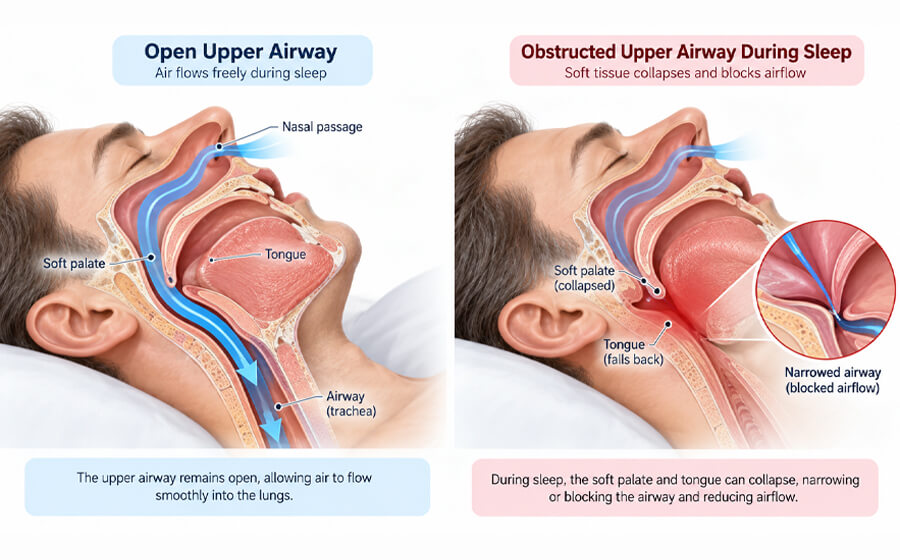
OSA occurs when the upper airway repeatedly narrows or closes during sleep. Breathing temporarily stops or becomes significantly reduced before the brain briefly wakes the body enough to reopen the airway.
These events may happen repeatedly throughout the night, fragmenting normal sleep even when the patient does not remember waking.
Why Is Sleep Apnea Connected With Obesity?
Obesity is one of the major risk factors for obstructive sleep apnea.
Excess soft tissue around the neck and upper airway can make the airway more likely to narrow during sleep. Abdominal obesity can also influence breathing mechanics.
However, weight is not the only factor. Jaw structure, tongue size, airway anatomy, age, sex, genetics and other physiological factors can also contribute.
This is why not every person with obesity has sleep apnea and not every patient with sleep apnea has obesity.
What Happens During an Episode of Sleep Apnea?
When the airway narrows or closes, airflow decreases even though the body continues trying to breathe.
Blood oxygen may fall. The brain detects the problem and briefly interrupts sleep so the airway can reopen.
The person may take a deep breath, gasp or snore before returning to sleep.
Because the cycle can repeat many times, normal sleep quality may be severely disrupted.
What Are Common Signs of Obstructive Sleep Apnea?
Common symptoms may include:
- Loud habitual snoring
- Observed pauses in breathing
- Gasping or choking during sleep
- Restless sleep
- Morning headaches
- Dry mouth on waking
- Daytime sleepiness
- Fatigue
- Reduced concentration
- Irritability or mood changes
Not every patient has all of these symptoms. Some people do not realise anything is wrong until a partner notices abnormal nighttime breathing.
Why Should Sleep Apnea Be Taken Seriously?
Sleep apnea is more than a snoring problem.
Repeated sleep disruption and intermittent reductions in oxygen can place stress on cardiovascular and metabolic systems.
Untreated OSA is associated with health concerns such as high blood pressure, cardiovascular disease, metabolic dysfunction, reduced daytime alertness and increased accident risk related to sleepiness.
Can Weight Loss Improve Sleep Apnea?
Yes, for many patients.
When excess body weight decreases, fat around the upper airway and abdomen may decrease as well. This can improve airway mechanics and reduce the tendency for the airway to collapse during sleep.
Weight loss may therefore reduce snoring, apnea frequency, oxygen disturbances, daytime sleepiness and overall OSA severity.
Does Sleep Apnea Always Disappear After Weight Loss?
No. This is an important point.
Weight loss can produce significant improvement without producing complete resolution.
If part of a patient's sleep apnea is related to jaw structure, airway anatomy or other non-weight factors, weight reduction may improve but not completely eliminate the condition.
For this reason, CPAP or other sleep-apnea treatment should not be stopped solely because a patient has lost weight.
What Is CPAP?
Continuous Positive Airway Pressure, or CPAP, is one of the most widely used treatments for obstructive sleep apnea.
A CPAP device delivers gentle positive air pressure through a mask during sleep. The pressure helps keep the upper airway open.
Weight management and CPAP should not necessarily be viewed as competing treatments. They may be used together when appropriate.
Why Is Sleep Apnea Important Before Bariatric Surgery?
Sleep apnea is particularly relevant when planning an operation requiring anesthesia.
Sedative medications, anesthesia and postoperative pain medication can influence breathing.
If a patient has known or suspected OSA, the surgical and anesthesia teams need to know so that perioperative planning and monitoring can be adjusted appropriately.
What If I Snore but Have Never Had a Sleep Study?
Snoring alone does not prove that a person has sleep apnea.
However, loud habitual snoring combined with obesity, witnessed breathing pauses, daytime sleepiness or high blood pressure may justify further evaluation.
Assessment may involve a sleep questionnaire, home sleep testing, laboratory sleep testing or specialist sleep-medicine evaluation.
How Is Sleep Apnea Severity Measured?
One commonly used measurement is the Apnea-Hypopnea Index, or AHI.